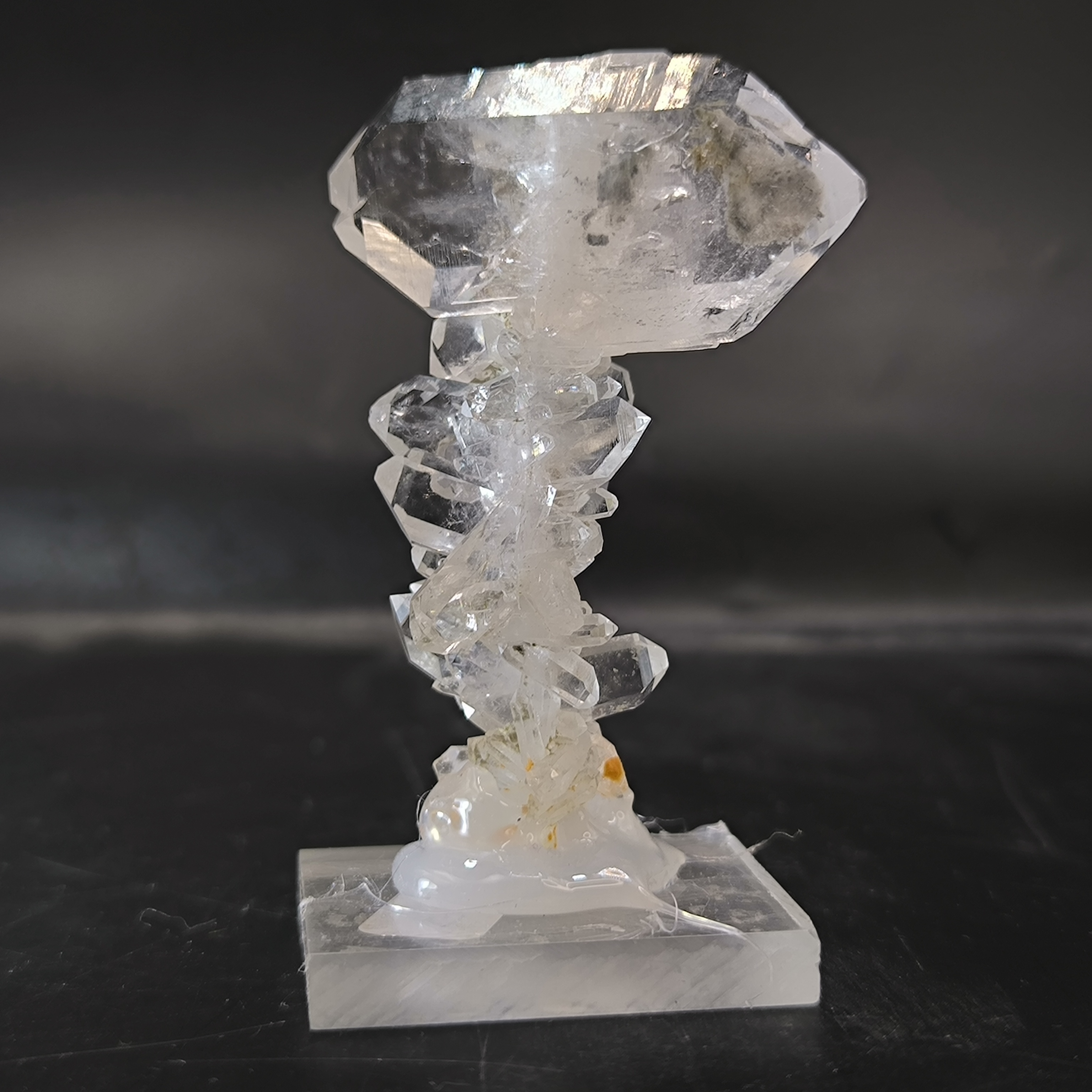
What is Quartz?
Quartz is one of the most abundant rock-forming minerals and one of the most commercially important mineral families, from clear crystals to colourful gem material.
Mineralogy and crystal structure
Reference formula: SiO2. This entry uses an exact alpha-quartz model from COD. Quartz has polymorphs and many colour or inclusion varieties, but Rose Quartz, Smoky Quartz, Rutilated Quartz, Phantom Quartz, Blue Quartz, Hematoid Quartz, Milky Quartz and Enhydro Quartz are kept as varieties and trade forms under this canonical Quartz page rather than duplicated as separate mineral species. Quartz is classified here as a framework silicate (tectosilicate) in the silica group and has a trigonal crystal system. Chemically it is silicon dioxide (SiO2); in the Strunz system the silica group is placed among the oxides. Typical hardness is 7–7 on the Mohs scale and specific gravity is approximately 2.6–2.7.
Commercial varieties of Quartz
Rose Quartz, Smoky Quartz, Rutilated Quartz, Phantom Quartz, Blue Quartz, Hematoid Quartz, Milky Quartz and Enhydro Quartz are varieties or trade forms of Quartz, not duplicate mineral species. Their colour, inclusions, transparency and treatment history create different market identities, while the canonical mineral identity remains Quartz. This guide keeps those forms together so collectors can compare them without fragmenting the mineral record.
Colour, lustre and habit
Typical colours include colourless, white, purple, yellow, brown, grey, green, blue. The usual prismatic, granular, massive habit and vitreous, greasy lustre help describe a specimen, but colour alone is not diagnostic.
Formation and notable localities
Quartz forms in or is associated with igneous and volcanic rocks, hydrothermal veins, metamorphic rocks, sedimentary rocks and open cavities. Important documented localities include Brazil, Madagascar, Arkansas, Switzerland, Japan and documented localities worldwide.
One mineral, many commercial faces
Quartz succeeds in both the specimen and jewellery markets because the same trigonal mineral can appear as a clear point, a purple amethyst, a smoky crystal, a rose cabochon or a dramatic included stone. Keeping these forms under one scientific page makes the mineral identity clear while still serving how collectors and buyers search.
Collecting and care
Clean with lukewarm water and a soft brush. Avoid sudden heat in included or treated stones, and avoid ultrasonic cleaning when fractures or delicate inclusions are present.