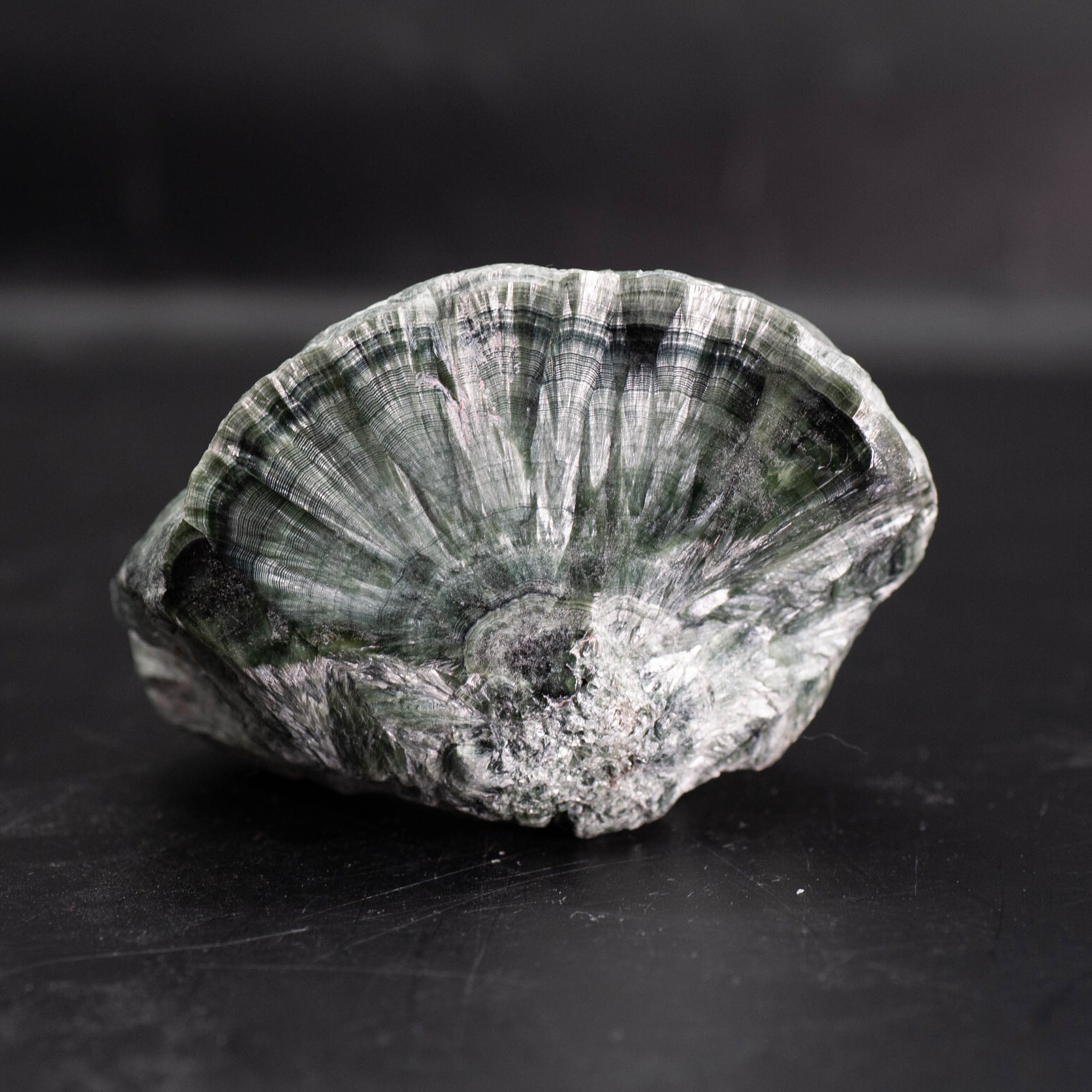
What is seraphinite?
Seraphinite is a trade and lapidary name, not a separate mineral species. It describes clinochlore with a radiating or plumose structure that creates silvery feather-like patterns against a deep green ground. Using both names on a label keeps the description attractive and mineralogically clear.
Mineralogy and structure
The underlying mineral is clinochlore, a magnesium aluminium phyllosilicate in the chlorite group. Clinochlore is monoclinic and has a layered structure, reflected in its easy cleavage and relatively low Mohs hardness of about 2-2.5. Its ideal formula is Mg5Al(AlSi3O10)(OH)8, though natural material can vary in iron content.
Colour and appearance
Seraphinite is usually dark to medium green with pale green or silvery chatoyant fibres. The visual effect is strongest on a polished surface cut to show the radiating structure. Pattern, polish quality and the direction of light are more meaningful for an ornamental piece than a single uniform colour value.
Formation and localities
Clinochlore forms in metamorphic and hydrothermal environments, including altered magnesium-rich rocks. Material sold as seraphinite is particularly associated with the Lake Baikal region of Siberia, Russia. A product label should state the confirmed locality of its own material where it is known.
Use in collections and mosaic
Because it is soft, seraphinite is best suited to protected display and decorative work rather than hard-wearing surfaces. In mosaic, its directional fibres can provide a quiet, wing-like texture when the plates are carefully oriented.