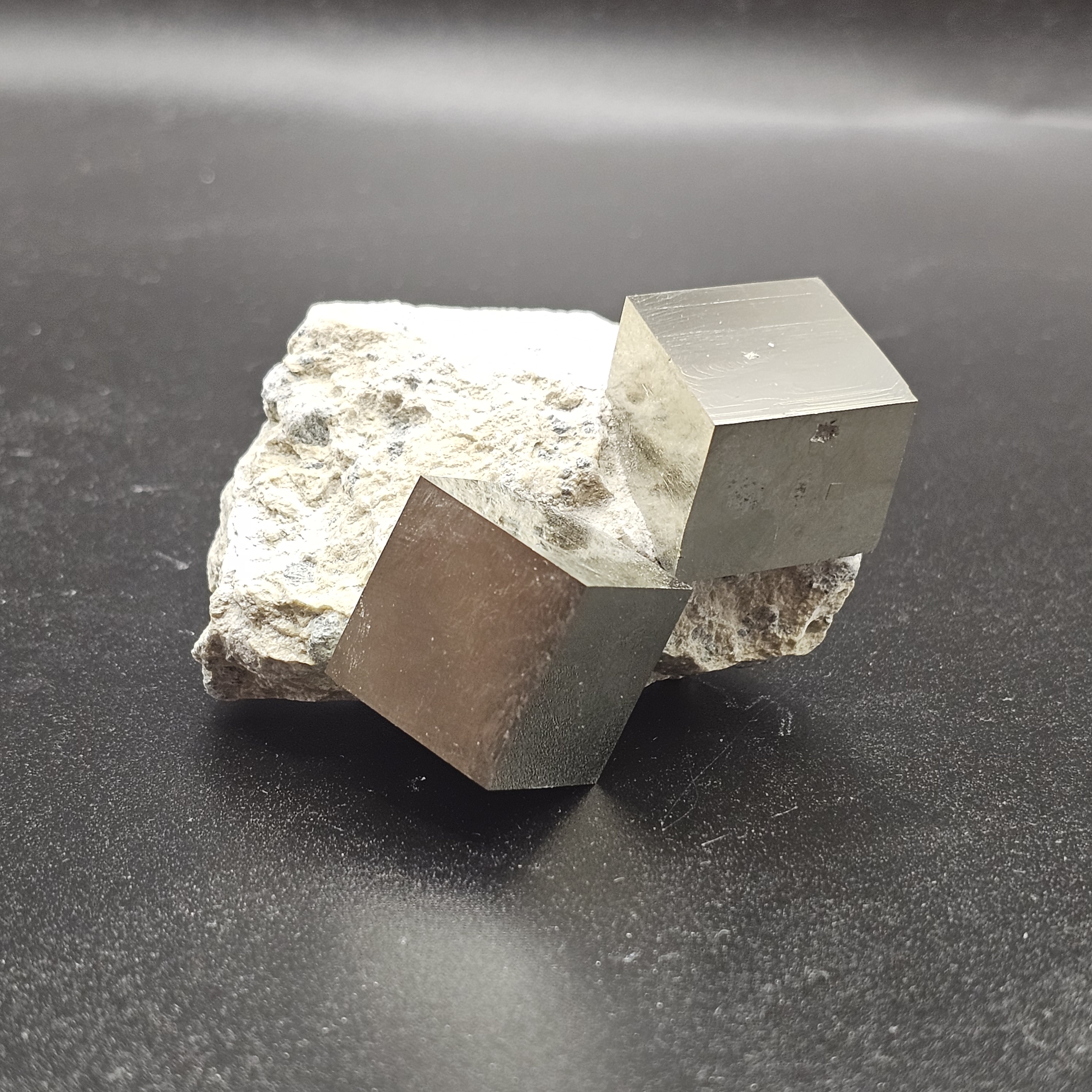
What is Pyrite?
Pyrite is the classic brassy metallic sulfide, prized for sharp cubes, dramatic clusters and its role in hydrothermal ore systems.
Mineralogy and crystal structure
Reference formula: FeS2. Pyrite is iron disulfide with a cubic framework. Its habit may be cubic, pyritohedral or massive, and surface tarnish can obscure the diagnostic metallic lustre. Pyrite is classified with sulfides and has a cubic crystal system. Typical hardness is 6–6.5 on the Mohs scale and specific gravity is approximately 4.9–5.1.
Colour, lustre and habit
Typical colours include brass-yellow, golden, grey, black. The usual cubic, pyritohedral, massive habit and metallic lustre help describe a specimen, but colour alone is not diagnostic.
Formation and notable localities
Pyrite forms in or is associated with hydrothermal veins, sedimentary rocks, coal measures, metamorphic rocks and magmatic sulfide deposits. Important documented localities include Spain, Peru, Italy, the United States, China, Russia and worldwide ore districts.
The golden collector classic
Pyrite sells because its geometry is immediate: a bright cube or radiating cluster looks engineered while recording the chemistry of a real ore-forming system.
Collecting and care
Keep dry and avoid prolonged humidity; clean gently and do not mistake pyrite for precious metal or expose it to aggressive chemicals.