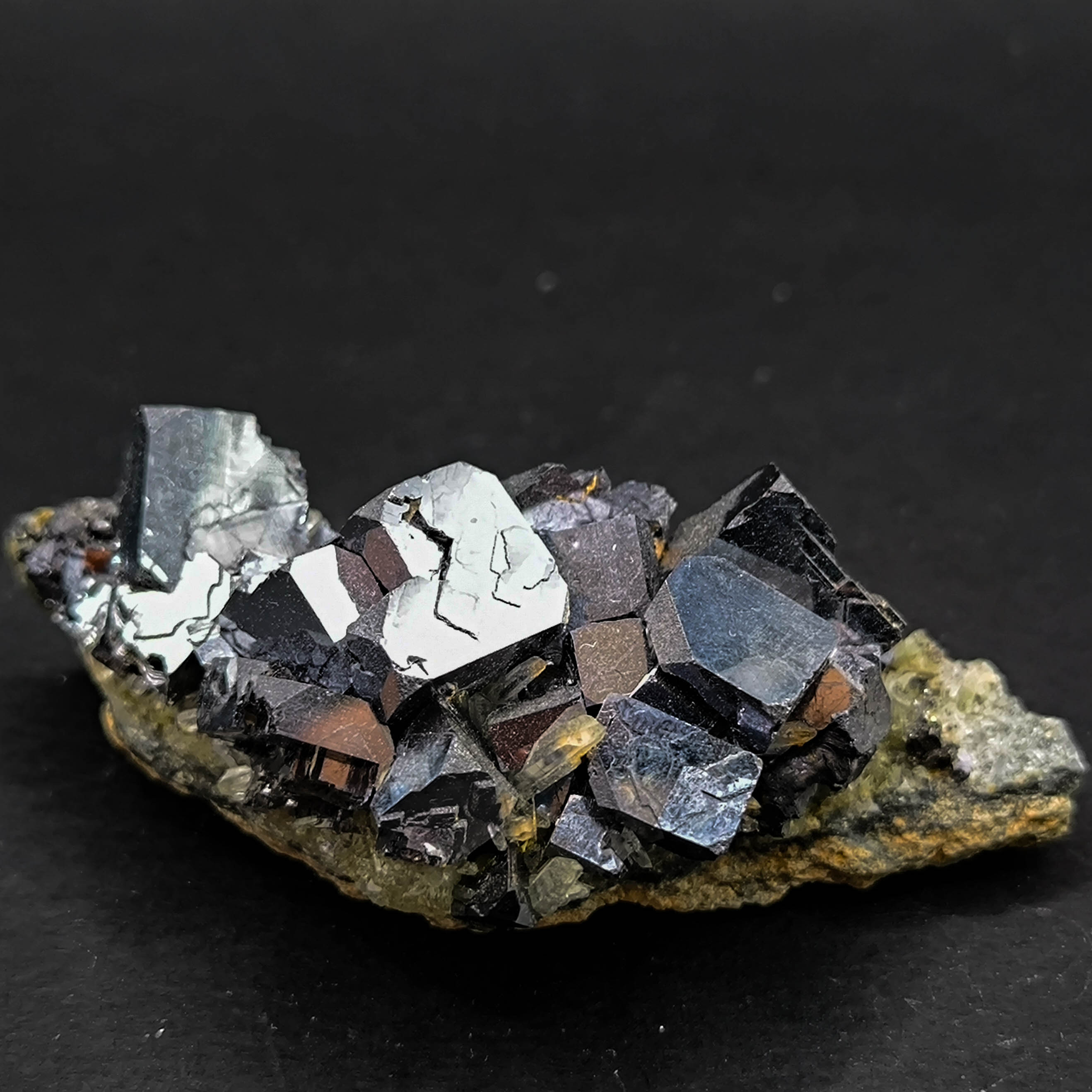
What is galena?
Galena is lead sulphide, PbS, and the principal ore mineral of lead. It is one of the most recognisable metallic minerals: fresh crystals are lead grey, remarkably dense and often develop cubic forms with bright metallic faces.
Mineralogy and structure
Galena belongs to the sulphides and crystallises in the isometric system. It has Mohs hardness about 2.5, perfect cubic cleavage and a very high specific gravity of around 7.6. These properties explain why a small galena specimen can feel unexpectedly heavy and why crystal corners and cleavage surfaces need protection.
Colour and appearance
Galena is lead grey with metallic to submetallic lustre. It may form cubes, octahedra, complex penetration twins or massive granular material. Fresh faces are bright, while oxidation and surface films can make older material duller. Matrix associations with quartz, fluorite, sphalerite or pyrite often make a specimen more informative.
Formation and localities
Galena forms in hydrothermal ore veins, replacement deposits in carbonate rocks, skarns and some sedimentary settings. It commonly occurs with zinc and copper sulphides. Important collector districts include the United States, Mexico, Peru, the United Kingdom, Germany, Romania and Italy.
Care in collections
Handle galena by its matrix or from below rather than gripping exposed crystal corners. Wash hands after handling any lead-bearing mineral and keep it away from food-preparation areas and children; a display specimen should remain a specimen, not a material for jewellery or play.