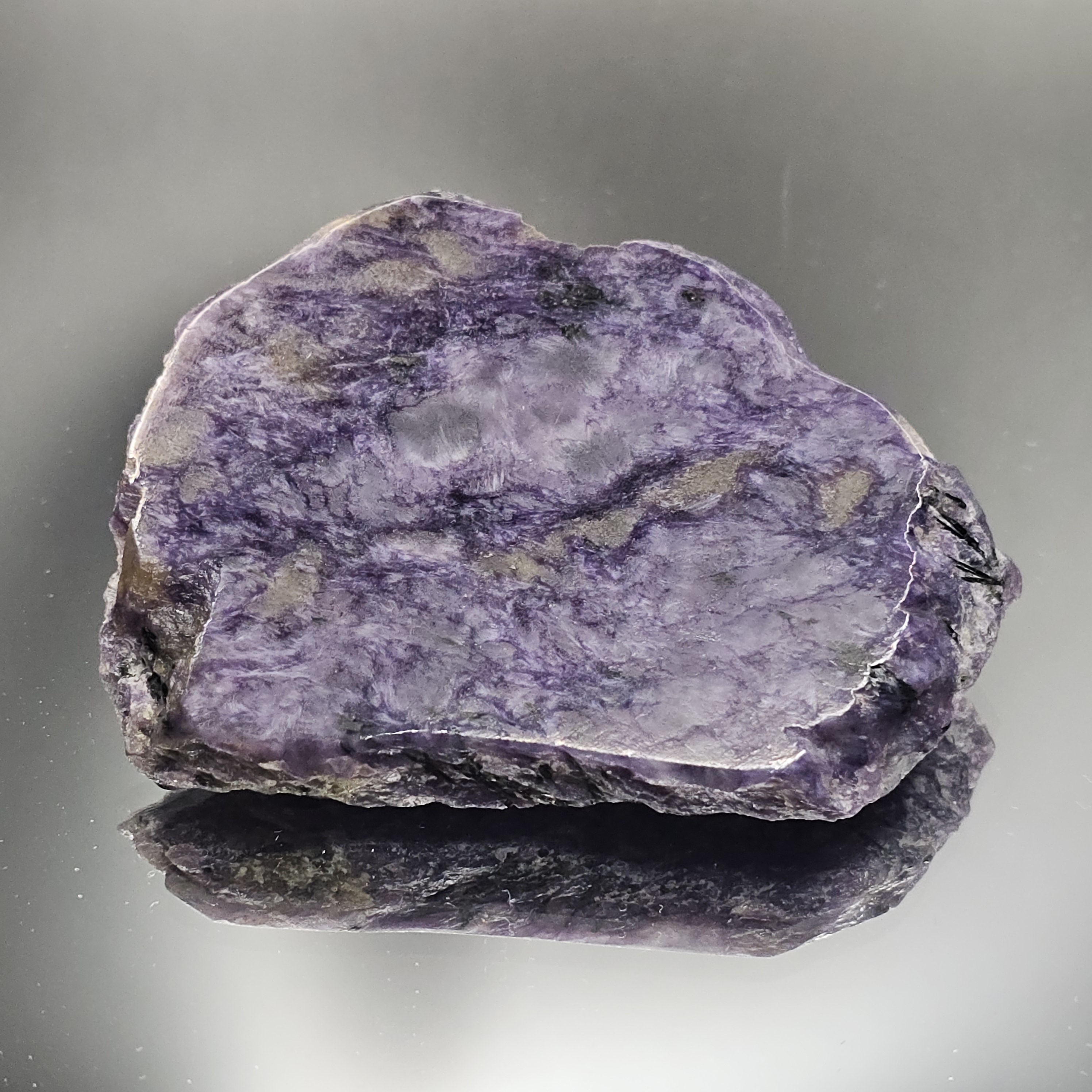
What is charoite?
Charoite is a rare complex silicate whose violet to lilac colour and swirling fibrous pattern make it instantly recognisable in polished material. It is an accepted mineral species, while charoitite is the name used for charoite-dominated rock. The two terms are related but should not be used interchangeably on a label.
Mineralogy and structure
Charoite is a hydrated potassium, calcium and strontium silicate with a complex chain-silicate structure. It is generally monoclinic and commonly occurs as fine intergrown fibres rather than separate, easily isolated crystals. This intergrowth is responsible for the silky, chatoyant-looking movement visible on a well-polished surface.
Colour and appearance
Colour ranges from pale lavender through saturated purple to brownish violet. White, black, green or orange areas may come from associated minerals in the rock. Each slab has its own pattern of waves, sprays and radiating fibres, so photographs and an individual description matter more than a generic colour name.
Formation and localities
Charoite is famously associated with the Murun Massif near the Chara and Tokko rivers in the Sakha Republic of Russia. There it formed during potassium-rich metasomatism where alkaline syenites altered limestone and related rocks. This exceptionally restricted geological setting is a central part of charoite's identity.
Use in collections and mosaic
Polished charoite is valued for its distinctive colour and directional structure. In inlay and mosaic, orientation determines how the fibres and colour bands read, so an artist selects and cuts each plate for the particular composition.