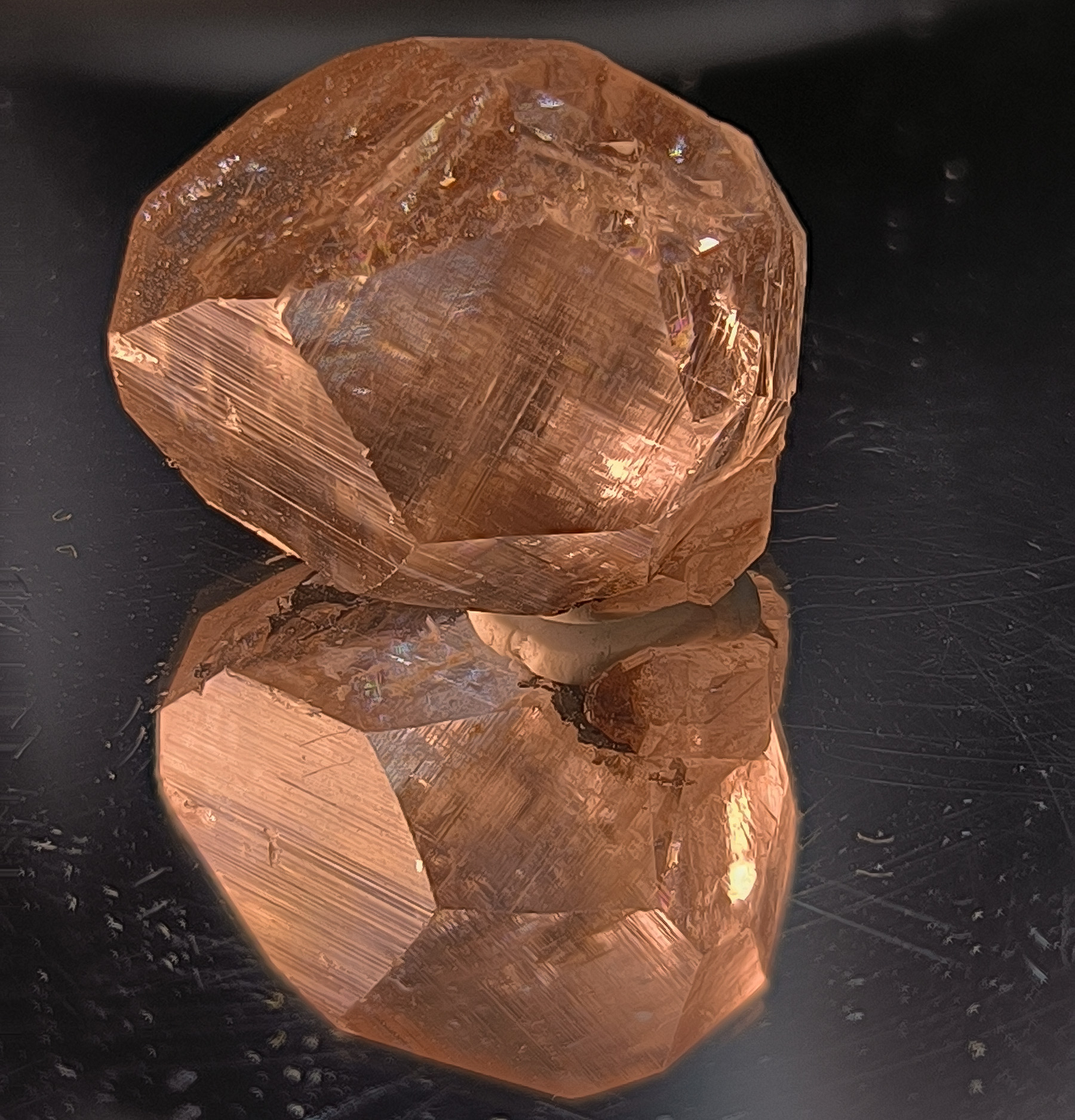
What is calcite?
Calcite is calcium carbonate, one of the most widespread minerals on Earth. It is a major component of limestone and marble, yet it also forms striking transparent, scalenohedral, rhombohedral and twinned crystals prized by collectors.
Mineralogy and structure
Calcite belongs to the carbonate minerals and crystallises in the trigonal system. It has Mohs hardness 3 and perfect rhombohedral cleavage. Its double refraction is especially visible in clear material often called Iceland spar, where an object seen through the crystal appears doubled.
Colour and appearance
Calcite may be colourless, white, honey-yellow, orange, green, blue, pink or brown. These colours can reflect trace elements or inclusions rather than a change in the basic calcium-carbonate chemistry. Crystal form is remarkably varied, so habit and locality are often as important as colour.
Formation and localities
Calcite forms in sedimentary rocks, caves, hydrothermal veins and metamorphic marbles. It can also be deposited from groundwater as stalactites, stalagmites and travertine. Classic collector localities include Elmwood Mine in Tennessee, Dalnegorsk in Russia, Chihuahua in Mexico, the Alps and many mining districts in Europe.
Use in collections
Calcite is a useful teaching mineral because its cleavage, low hardness and crystal forms are easy to observe. Despite its abundance, exceptional transparent crystals, complex twins and fine associations remain highly collectable.